








The Guardian
Democratic senators investigate data centers’ effects on electricity prices
Wed, 17 Dec 2025 10:11:14 GMT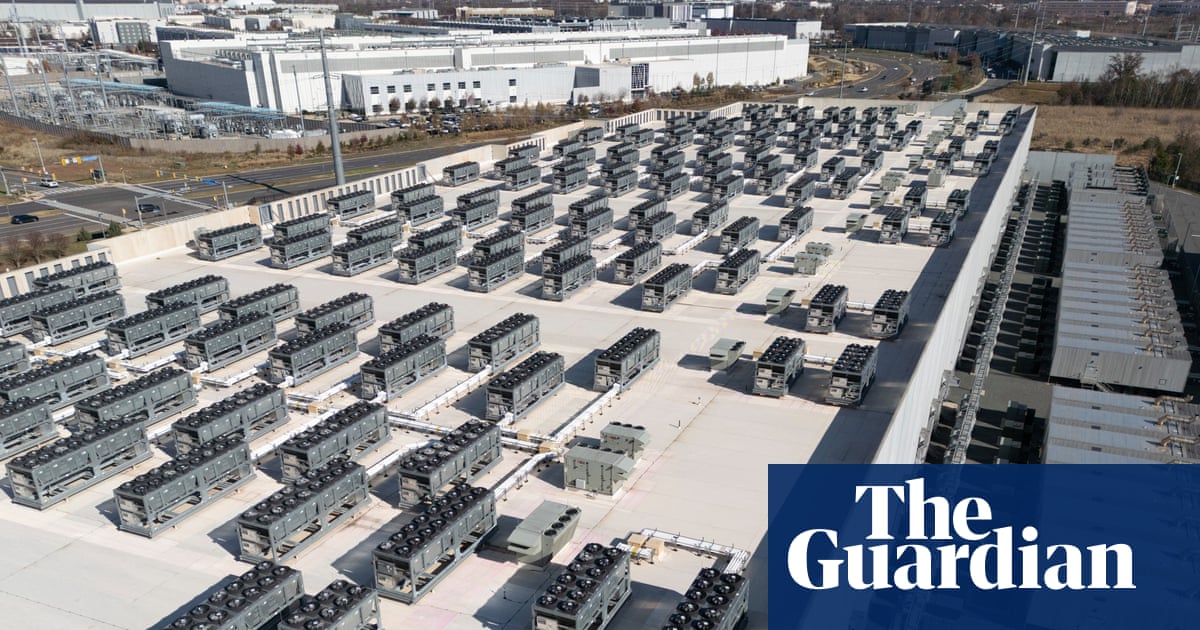
Three Democratic US senators announced on Tuesday that they are investigating whether big tech companies are passing the soaring utility costs of “energy-guzzling” data centers on to ordinary Americans. The trio sent letters to the heads of Google, Microsoft, Amazon and Meta as well as the data center operators CoreWeave, Digital Realty and Equinix asking for greater transparency, cost-sharing and accountability.
Elizabeth Warren of Massachusetts, Chris Van Hollen of Maryland and Richard Blumenthal of Connecticut wrote that they were alarmed by reports that these data centers caused residential electricity bills to “skyrocket”. Regions with significant data center activity have already endured price increases by as much as 267% over the past five years, the three lawmakers wrote. According to the Energy Information Administration, a federal agency, the average cost of a US family’s electricity bill had risen 7% year-over-year as of September.
“Through these utility price increases, American families bankroll the electricity costs of trillion-dollar tech companies,” they stated, demanding that data centers and tech companies “pay their fair share of their electricity rates” and “a greater share of the costs upfront for future energy usage”.
Lawmakers asked companies for more information about their current and projected number of data centers, and their energy usage, as well as what actions have been taken to prevent electricity costs from being passed on to consumer energy bills.
They also inquired about the tax deductions or other financial incentives these companies received from state and local governments, as well as payments they made to lobbyists and consultants to advocate for the construction of data centers. They requested a response no later than 12 January.
The rapid expansion of AI – and the fact that a single data center can “use enough electricity to power hundreds of thousands of homes”, according to the senators – means that utility companies have spent billions of dollars building new transmission lines and power plants. Data centers could account for 12% of the country’s power consumption by 2028, according to the US Department of Energy. About one-third of the country’s more than 4,000 data centers are located in three states: Virginia, Texas and California.
At least one study questions the link between data centers and increasing electricity prices. A recent Lawrence Berkeley National Laboratory study found that data centers may have actually helped reduce average retail electricity prices. Experts say utility companies can spread fixed infrastructure costs among more power customers.
In the letters, lawmakers highlighted specific examples of tech companies publicly insisting they do not want taxpayers to be overburdened by data centers, while simultaneously opposing state and local efforts to regulate them.
“Tech companies have paid lip service in support of covering their data centers’ energy costs, but their actions have shown the opposite,” the letters noted.
Google, Amazon, CoreWeave and Equinix did not immediately respond to requests for comment. Digital Realty said in an emailed statement that it “looks forward to working with all elected officials to continue to invest in the digital infrastructure required to support America’s leadership in technology”. Meta and Microsoft declined to comment.
While the senators’ letters focus mostly on the financial burden of data centers, the massive structures’ enormous energy usage also comes with a significant climate cost. A Cornell study published last month in Nature Sustainability found that data centers could annually consume as much water as 6 million-10 million Americans and emit as much carbon dioxide as 5m-10m cars.
Opposition to the environmental and financial costs associated with data centers is growing in the US. Local efforts across the country have blocked or delayed roughly $64bn in data center projects, according to a report published earlier this year by Data Center Watch. The details around these projects and their proposed construction are often obscured under the guise of trade secrets, which lawmakers say allows tech giants to operate in secrecy.
“The contracts between data centers and utility companies that underlie these arrangements are almost always confidential, leaving the public in the dark on why their electric bill keeps going up,” they wrote.
Stay in touch
Keep informed with the most important events in market and advanced calculators.



Subscribe
Subscribe to our newsletter! Stay always in touch!
Disclaimer:
Disclaimer: The information provided by The People’s Economist (TPE) in our financial calculators and dashboards is for general informational purposes only and is not intended to provide specific financial or investment advice. The calculations provided by these tools are based on certain assumptions that may vary with your specific circumstances. Though TPE does our best to assure the accuracy of our calculators, we make certain simplifying assumptions in some cases and the results of the financial calculators are not guaranteed and are not a substitute for professional financial advice. Users should seek the advice of a finance professional before making any financial decisions. Though we do our best to ensure the accuracy of the calculators, TPE is not responsible for any errors or omissions, or for any action taken in reliance on information contained on this website. TPE expressly disclaims all liability in respect of any actions taken or not taken based on any contents of this website. By using TPE financial calculators and dashboards, you agree to hold TPE harmless from any and all losses, liabilities, or expenses incurred as a result of using the information provided. The use of TPE Website and its contents does not create a client relationship with TPE. TPE may update or modify this disclaimer at any time without prior notice. By continuing to use TPE’s financial calculators after any changes to this disclaimer, you accept and agree to any and all modifications. Please contact us with any questions or concerns about this disclaimer or its use of financial calculators