




Fortune
Anthropic accidentally leaked details of a new AI model that poses unprecedented cybersecurity risks
Fri, 27 Mar 2026 20:22:45 GMT
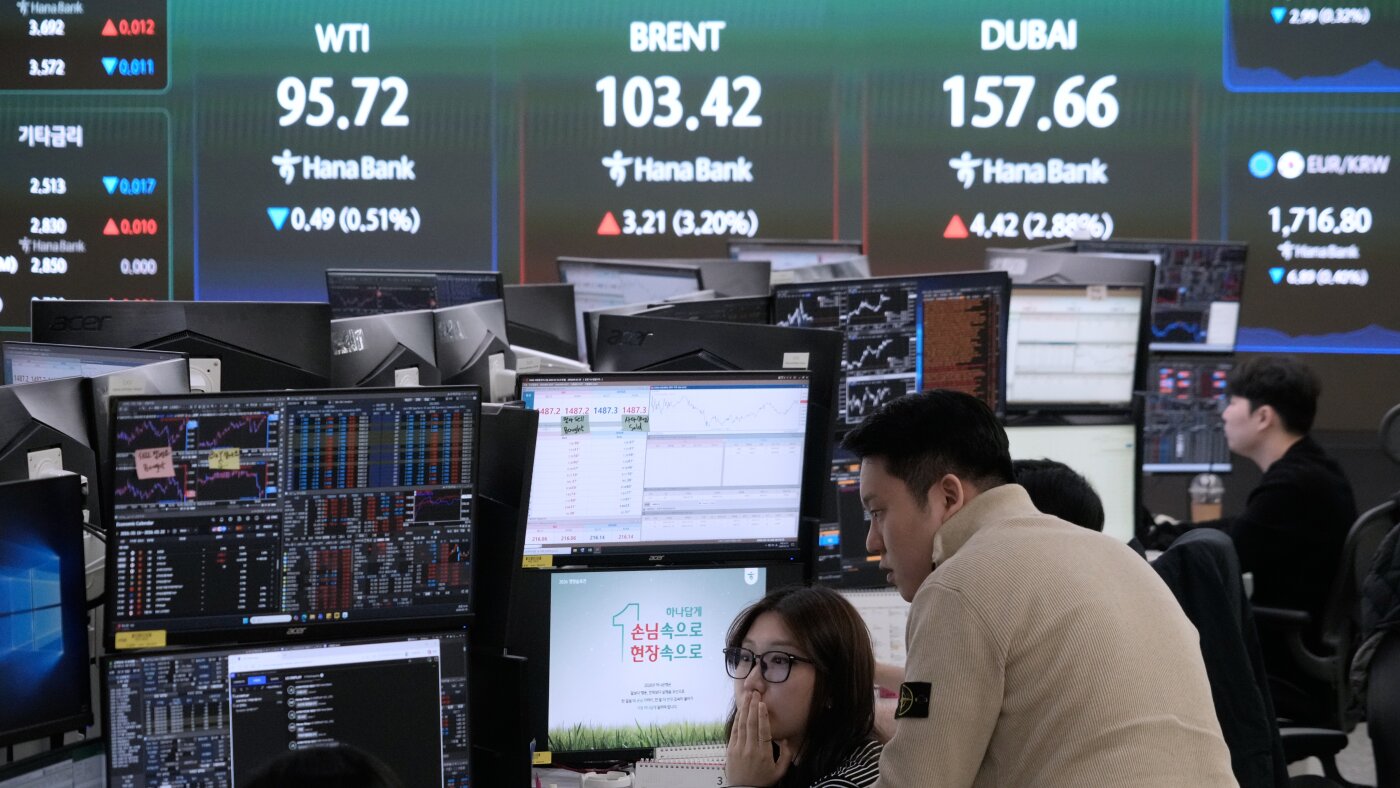
Oil was over $110 per barrel and rising this morning. S&P 500 futures were down 0.14% prior to the open in New York. The index lost 1.74% yesterday. “Both the S&P 500 (-1.74%) and the Nasdaq (-2.38%) saw the biggest declines since the start of the war and fell back to their lowest levels since September,” Deutsche Bank’s Jim Reid lamented in a note seen by Fortune this morning. With the exception of China’s CSI 300 (up 0.56%), all the major markets in Asia and Europe were down today. South Korea’s KOSPI was the best performer, down 0.4%. Europe’s Stoxx 600 declined 0.86% in early trading. Japan’s Nikkei 225 was off 0.43%.
Unrest in Europe’s bond market: “Growing fears of a stagflationary shock also weighed on bond markets, with some huge moves for European sovereigns in particular. In fact, yesterday saw 10yr [German] bund yields (+11.5bps) post their biggest daily jump in a year,” Reid said, “That pushed the 10yr bund yield up to 3.07%, its highest closing level since mid-2011, back when the Euro crisis was in full swing."
TradingEconomics.com
ONE BIG THING
Exclusive: Anthropic left its next AI model sitting on the open internet
In what appears to be a significant security breach—discovered by Fortune’s Bea Nolan—Anthropic inadvertently revealed details about an in-development AI model, named “Claude Mythos,” on its company website. The trove of unsecured data also included an exclusive CEO event, images, and PDFs. In total, there appeared to be close to 3,000 assets that had not previously been published to the company’s public-facing news or research sites that were nonetheless publicly accessible.
Anthropic’s “Mythos” will be its most capable and possibly dangerous yet, the documents say. It will be so powerful that the company believes it poses unprecedented cybersecurity risks, Fortune ’s Nolan discovered .
U.S. judge blocked the Pentagon ’s "Orwellian notion" of labelling Anthropic a supply-chain risk to ban Claude from government work .
Journalism on steroids: Using AI, Fortune ’s Nick Lichtenberg produced more stories in the last six months than any of his colleagues delivered in a year, the Wall Street Journal reports in a story about how we’re using artificial intelligence in our newsroom.
IRAN
Trump presses pause on impending destruction
In a confusing set of posts on Truth Social last night, President Trump announced he would give Iran 10 more days—until April 6—before he orders the destruction of the country’s energy infrastructure, while negotiations continue. He said, “Talks are ongoing and, despite erroneous statements to the contrary by the Fake News Media, and others, they are going very well.”
Earlier in the day, Trump had said the Iranians were both anxious for a deal and not being serious. “The Iranian negotiators are very different and ‘strange.’ They are ‘begging’ us to make a deal, which they should be doing since they have been militarily obliterated, with zero chance of a comeback, and yet they publicly state that they are only ‘looking at our proposal.’ WRONG!!! They better get serious soon, before it is too late.”
He yelled at NATO, too. Of course.
The Pentagon is considering sending 10,000 more troops to the Middle East, Axios reports. “It is another signal that a U.S. ground operation in Iran is being seriously prepared,” the outlet says.
Iran's oil windfall: The country being bombed is cashing in at $139 million a day
While most Gulf oil producers are blocked from exporting through the Strait of Hormuz, Iran’s export volumes are largely unaffected and the regime is benefitting greatly from the increase in the price of oil caused by the war, Bloomberg says. Tehran probably earned $139 million a day from oil sales in March, up from $115 million the month before.
Meanwhile, Iran has tightened its control of the Strait and will want to retain authority over it once the conflict is over, the Financial Times reports .
PUBLIC RELATIONS
Supermicro CEO: We are the real victims here!
In an extraordinary but little-noticed public letter on its website, Supermicro CEO Charles Liang insisted his company was innocent in the federal government’s criminal indictment brought against the company’s founder, who is accused of allegedly smuggling $2.5 billion of GPUs into China. “Supermicro is NOT named as a defendant in the indictment,” Liang said. “It appears that Supermicro has been a victim of the elaborate schemes orchestrated by these individuals, which deceived both federal authorities and our internal compliance team.”
CHART OF THE DAY
It now costs—in theory—an extra $24 million to get a tanker through the Strait of Hormuz
“In March 2026, tanker rates for Very Large Crude Carriers (VLCCs) leaving the Middle East to Asia were the highest since at least November 2005, when data were first recorded,” according to the U.S. Energy Information Administration. The closure of the Strait of Hormuz has added $14 to the cost of each barrel of oil, this chart shows. A VLCC can carry 2 million or more barrels, and thus the cost per ship is around $28 million or more, up from around $4 million before the war—a $24 million increase.
NUMBER OF THE DAY
$3 billion
Retail investors have left the building: Normally, individual stock buyers—day traders and people saving into retirement plans—add about $6.8 billion per week into the stock market, according to J.P. Morgan’s Arun Jain and his colleagues. But the war has them skittish: They net bought only $3 billion in the most recent week recorded by Jain. “Monday stood out as particularly weak: Despite a broader return to market enthusiasm, retail appeared to capitulate—turning net sellers for the first time in 9 months,” he wrote in a note to clients.
MORE FROM FORTUNE
Defense startup Shield AI is projecting more than $540 million in revenue this year as valuation more than doubles to $12.7 billion, by Jessica Mathews
Melinda French Gates has a rule for conflict at work: Wait 48 hours before saying anything, by Sydney Lake
Dow CEO warns petrochemical shortage from Iran war could fuel inflation for rest of the year, by Jordan Blum
Cursor CEO warns vibe coding builds ‘shaky foundations’ and eventually ‘things start to crumble’, by Marco Quiroz-Gutierrez
Housing giant Fannie Mae to accept crypto-backed mortgages for the first time, By Carlos Garcia
THE FRONT PAGES TODAY
Israeli military doubts war will topple Iranian regime - FT
Ukraine is running out of cash to pay for the war as aid falters - Bloomberg
Zelensky courts Saudi support as U.S. reportedly weighs redirecting Ukraine aid to Middle East - CNBC
Trump’s signature to be added to U.S. dollars - NYT
ONE MORE THING
A big chunk of your tax refund is going on higher gas prices
Easy come, easy go: Many Americans got a tax boost this year, due in large part to changes in the “One Big Beautiful Bill Act.” But those benefits are being eaten away by higher gasoline prices due to the Iran war, according to Andy Laperriere and his colleagues at Piper Sandler. The total benefit to Americans was about $106 billion in retroactive tax relief. But higher gas prices eat into that at a rate of about $25 billion to $30 billion per quarter. The hit isn’t falling evenly: “Higher gas prices for one quarter would offset 80% of the retroactive tax cuts for the bottom quintile, 30% for the second quintile, and 20% for other households,” Lapierriere says.